

Google continues to evolve its advertising platform, and the latest Google Ads updates are centered around stronger audience control, clearer campaign objectives, and deeper AI integration. For businesses investing in Google Ads management, these changes can significantly impact campaign structure, targeting accuracy, and return on ad spend.
As a performance-focused digital marketing agency, Pepi Digital closely monitors platform updates to help brands adapt their strategies effectively. Here is a breakdown of the five most important changes and what they mean for advertisers.
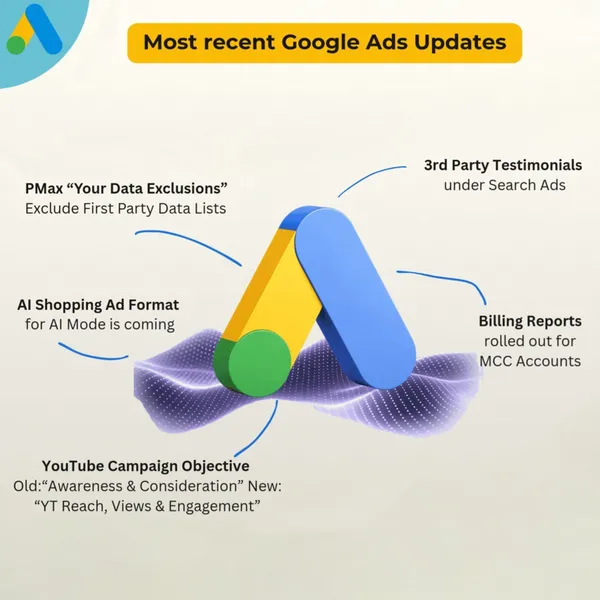
1.Performance Max “Your Data Exclusions” – Greater Audience Precision
A major update to Performance Max campaigns now allows advertisers to exclude first-party data lists. Previously, audience signals were treated as recommendations. With this change, businesses can actively prevent specific customer segments from being targeted.
This is especially useful for:
- Excluding existing customers from acquisition campaigns
- Separating prospecting and retention strategies
- Avoiding internal competition between campaigns
For brands running PPC advertising, this adds a valuable layer of strategic control within automated campaigns. It allows for cleaner segmentation and more efficient budget allocation.
2. Third-Party Testimonials in Search Ads
Google is currently testing the display of third-party testimonials directly within Search Ads. Ratings and review signals could appear under ads, reinforcing credibility at the first point of interaction.
For businesses investing in search engine marketing, trust signals are critical. If rolled out widely, this feature could improve click-through rates and strengthen brand perception. Companies focusing on conversion rate optimization should prioritize maintaining strong reviews and consistent online reputation management.
3. Clearer YouTube Campaign Objectives
The former “Awareness & Consideration” objective has been restructured into a clearer framework: YouTube Reach, Views & Engagement.
With the growth of YouTube advertising, this update provides advertisers with more straightforward goal alignment. Campaign objectives are now easier to define and measure, helping brands tailor their content strategy to specific performance outcomes.
4. MCC-Level Billing Reports
Billing reports are now accessible at the MCC (Manager Account) level, simplifying oversight for agencies and businesses managing multiple accounts.
For a digital marketing agency like Pepi Digital, this update enhances operational efficiency and financial transparency. It reduces the need to navigate individual accounts and streamlines reporting processes for clients.
5. AI Shopping Ads in Google AI Mode
Google is preparing to introduce AI-powered Shopping ads that will appear within Google AI Mode through Standard Shopping and Performance Max campaigns.
Businesses leveraging Google Shopping ads should prepare for this shift by ensuring product feeds are optimized, images are high quality, and data accuracy is maintained. As AI-driven placements expand, structured and well-optimized data will become even more important.
What These Updates Mean for Businesses
The direction is clear: more automation, more AI, and greater advertiser control. Businesses that regularly review and refine their digital marketing strategy will be better positioned to adapt to these changes.
At Pepi Digital, we help brands navigate evolving advertising platforms with strategic planning and data-driven execution. Staying updated with Google Ads updates is no longer optional it is essential for maintaining a competitive advantage and maximizing performance in today’s digital landscape.